
 English





 Home
HomeNotice from the State Administration for Market Regulation on Issuing the "Action Plan for Enhancing Specialized Capability in Quality Certification (2025–2030)"
 2026.06.24
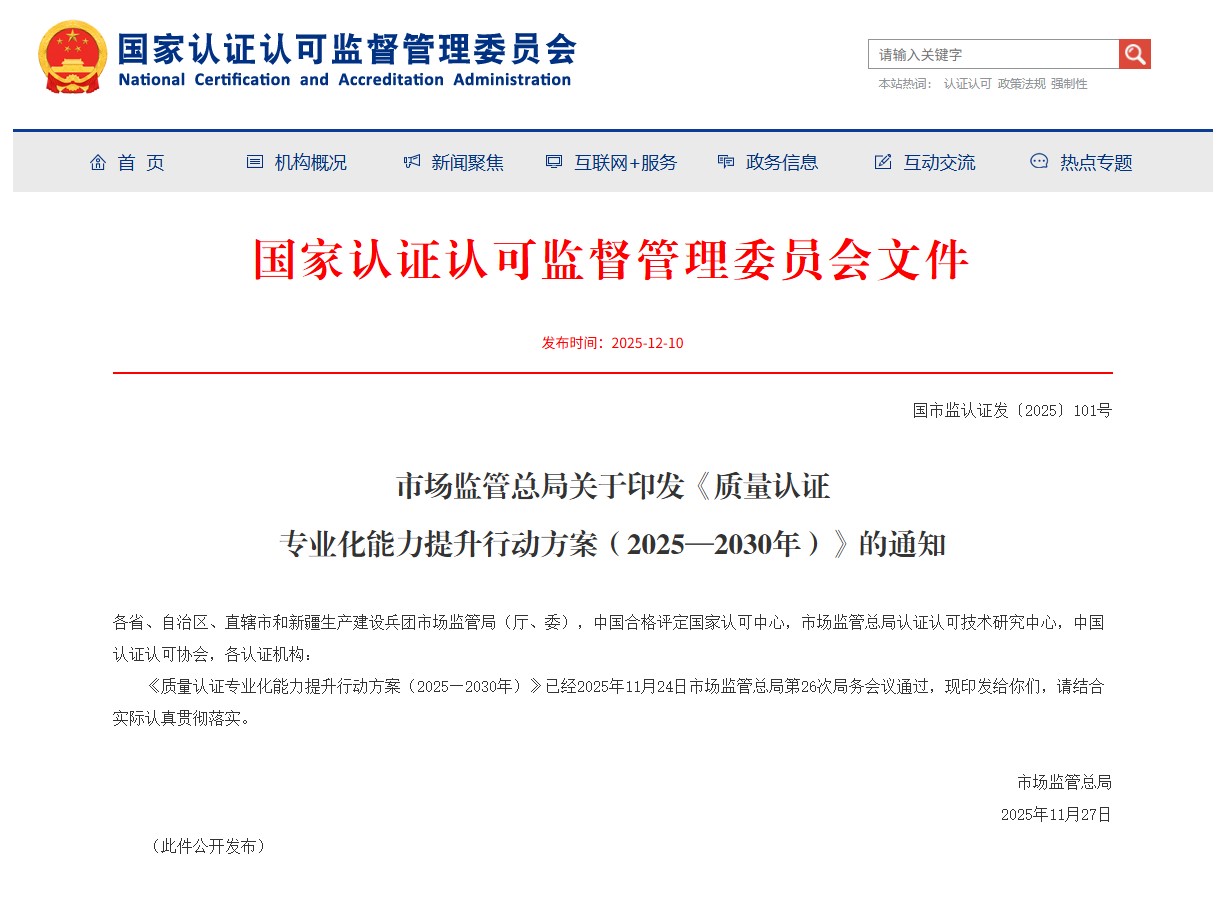
The "Action Plan for Enhancing the Professionalization Capability of Quality Certification (2025–2030)"
Market Supervision Bureaus (Departments, Commissions) of all provinces, autonomous regions, municipalities directly under the central government, and Xinjiang Production and Construction Corps, China National Accreditation Center for Conformity Assessment, State Administration for Market Regulation Certification and Accreditation Technology Research Center, China Certification and Accreditation Association, and all certification bodies:
The "Action Plan for Enhancing Specialized Quality Certification Capabilities (2025–2030)" was approved at the 26th bureau meeting of the State Administration for Market Regulation on November 24, 2025. It is hereby issued to you. Please conscientiously implement it in accordance with actual conditions.
State Administration for Market Regulation
November 27, 2025
(This document is publicly released)
Action Plan for Enhancing Professional Quality Certification Capability (2025–2030)
01 Overall requirements
Guided by Xi Jinping Thought on Socialism with Chinese Characteristics for a New Era, thoroughly implementing the spirit of the 20th National Congress of the Communist Party of China and its plenary sessions, carrying out the decisions and deployments of the CPC Central Committee and the State Council on comprehensively strengthening the quality certification system, adhering to the combination of an effective market and proactive government, unswervingly advancing the construction of a quality-strong nation, focusing on the professional capacity improvement needs of certification institutions and personnel, and comprehensively enhancing the professional capabilities of certification institutions in organizational management, technology R&D, talent cultivation, service improvement, brand building, and digital intelligence construction , enhance the professional capabilities of certification personnel, promote the realization of the value of quality certification, shift the development of the quality certification industry from quantity-based to quality-oriented and efficiency-oriented, accelerate high-level certification technology self-reliance and strength, and provide solid support for high-quality economic and social development and high-level opening up during the 15th Five-Year Plan period.
02 Main Objectives
Firmly enforce the primary responsibilities of certification bodies and personnel. By the end of 2026, the system for quality managers in certification bodies will be fully implemented, with a 100% staffing rate for quality directors. A traceability system has been established across the entire industry, covering the entire certification activity process and the entire certification cycle, characterized by "verification rules can be traced, certification processes can be traced, and certification results can be traced." New achievements have been made in the development of professional capabilities in the certification industry. By the end of 2028, certification bodies' service capabilities will be significantly enhanced, certification supply will become more precise, and certification results will be more authoritative and reliable. The number of institutions leading and participating in the formulation of various standards will exceed 200. Create a well-structured tiered talent management and utilization model, and launch a batch of certified professional benchmark projects. By 2030, there will be no fewer than 320 certification institutions recognized as high-tech enterprises, effectively addressing the issues of China's certification industry having weak international influence, low credibility, and insufficient specialization. As a tool of the market economy, quality certification has been fully demonstrated in boosting consumption, supporting the development of new quality productive forces, and facilitating international trade. It has formed a specialized capability system guided by the government, coordinated by the industry, led by institutions, and supported by talent, achieving high-quality development of the quality certification industry.
03 Strengthen the bottom line of quality certification compliance
(1) Deepen the Promotion of Certification Bodies' Compliant Operations 1. Strengthen the primary responsibility of certification bodies. Strictly implement the primary responsibility of certification bodies for certification results and joint responsibility for product quality, and improve the accountability mechanism for certification practitioners throughout the entire process. Promote certification bodies to establish and improve a systematic compliance operation system covering competency requirements, impartiality, process control, complaint handling, information disclosure, and confidentiality requirements. Strengthen risk management and monitoring, regularly conduct internal audits and management reviews, and focus on process management of key certification processes, certificates, certification marks, and follow-up investigations. Strengthen management of certification personnel such as quality managers, and improve management systems for qualification review, employment and selection, ability evaluation, education and training, and rewards and penalties. 2. Strengthen the technical foundation of certification bodies. Strengthen basic theoretical research on certification, enhance research on evaluation technologies such as selection, determination, supervision, review, and certification of certification activities, enhance technical research on practitioner competency evaluation, certification risk management, certification informatization, and establish a scientific, systematic, authoritative, and widely accepted certification technology system. Guide certification bodies to form certification technology research teams, focusing on assessment of certification needs and cultivating the ability to design certification rules. Strictly adhere to the management system for formulating and filing certification rules, formulate legal, compliant, and scientifically applicable certification rules, explore intellectual property protection paths that align with certification technology development, and provide high-quality certification rules that meet market demand and lead industry development.
(2) Deepen the Promotion of Certified Personnel's Compliance Practice 1. Improve the accountability mechanism for certification personnel. Deepen reform of the qualification approval system for certification institutions, and refine the competency requirements for full-time certification personnel in different fields. Improve the accountability mechanism for certification personnel during certification activities, implementing the systems of "who signs, who bears responsibility" and "signer bears overall responsibility." Establish credit files for employees, implement dynamic personnel management, and improve the mechanism for punishing dishonesty. 2. Consolidate the primary responsibility of the registration body for certified personnel. Tracking changes in authentication technology, dynamically adjusting specification documents, ensuring the continuous and effective registration of personnel. Optimize the registration and evaluation process for certification personnel, providing strong support for certification bodies in selecting and employing personnel. Establish a "lifelong learning" system for certified personnel, enrich continuing education methods, and design targeted knowledge systems and training courses. Formulate standardized management requirements for certified personnel registration bodies, strengthen comprehensive management of personnel registration-related work, and implement effective supervision.
(3) Leverage the Self-Regulatory Role of Industry Organizations 1. Improve the level of standardized industry management. Strengthen the management of certification industry organizations, improve the industry self-discipline system, effectively play the role of "behavioral guidance, rule constraints, and rights protection," and achieve industry self-discipline and co-governance. Optimize the system for transferring registered and certified personnel to practice institutions to ensure reasonable personnel mobility. Improve the certificate conversion mechanism and regulate the healthy development of the industry. Establish a risk monitoring and early warning system for certification personnel, build a panoramic profile of certification auditors, and improve the refined and standardized management level of certification personnel. 2. Strengthen the self-discipline and restraint mechanism for practitioners. Enhance employees' sense of responsibility and legal compliance, strictly abide by national laws and regulations, and resolutely resist illegal activities such as false certifications and buying and selling certificates. Strengthen self-discipline of employee behavior, improve personnel constraint mechanisms, and ensure that practitioners continuously comply with behavioral norms and professional ethics. Strengthen the quality certification industry conduct and foster practitioners' awareness of innovation, excellence, and quality through quality. Strengthen information sharing and work coordination, promptly detect personnel violations, and strictly handle them according to regulations.
04 Raising the professional quality certification standards
(4) Vigorously Promote Credit Enhancement and Excellence Creation of Certification Bodies 1. Strengthen the improvement of the innovation capabilities of certification institutions. Encourage certification bodies to focus on national development planning and strategy, focus on key fields, new technologies, new industries, new business formats, new models, and future industries, establish R&D funds, focus on specialized capabilities and innovative development, strengthen research team building, deepen cooperation with industry enterprises and certification and accreditation technology research institutions, jointly tackle key technologies, and promote the construction of a modern quality certification theoretical, policy, and technological innovation system. Promote the deep integration of certification technology with industrial upgrading, accelerate the transformation and application of scientific research achievements, and actively obtain certifications such as "High-Tech Enterprise." 2. Strengthen the comprehensive service capabilities of certification institutions. Guide certification bodies to continuously improve their comprehensive service capabilities, focusing on building a service system characterized by "internal standardization and differentiated inter-institution integration." Develop a full-process, full-cycle quality certification service model for certification activities, helping certified organizations become better and stronger. By applying "chain thinking," the concepts, methods, and tools of quality certification are extended upstream and downstream of the industry chain, promoting mutual recognition of certification results across the chain, facilitating supplementation, extension, stabilization, and strengthening of chains, and achieving effective transmission of certification value in the construction of a modern industrial system. 3. Strengthen the brand capability of certification institutions. Guide certification bodies for high-quality development, support their international layout, actively participate in international cooperation, and promote mutual recognition through flexible, pragmatic, and effective cooperation. Certification bodies are encouraged to rely on strong professional capabilities and credibility to accelerate the cultivation and enhancement of certified brands, enrich brand cultural connotations, strengthen trademark brand asset management and protection, expand publicity channels, actively fulfill social responsibilities, and enhance the reputation of certification bodies. 4. Enhance the digital intelligence capabilities of certification institutions. Certification bodies are encouraged to incorporate digital and intelligent transformation into their development plans, strengthen digital and intelligent infrastructure construction, build specialized data systems, conduct research and application of key technologies for digital and intelligent certification, and use modern information technologies such as big data, blockchain, and artificial intelligence to explore new models of digital and intelligent certification, promote monitoring and traceability of certification information, and improve the efficiency of quality control and control.
(5) Vigorously Promote Strengthening and Empowering Certification Personnel 1. Continuously improve the professional capabilities of certified personnel. Improve the capability assessment mechanism for certification personnel, build a knowledge system that meets the needs of innovation and development in quality certification, and form targeted and long-term personnel training plans. It strongly advocates that certification bodies leverage their professional capabilities and expert team advantages to create diversified models for enhancing the capabilities of certification personnel. 2. Build a diversified supply mechanism for certified talent. Promote more higher education institutions to offer quality certification courses and broaden channels for professional talent cultivation. Focus on talent gaps, establish a rapid cross-industry mechanism for the introduction of high-level professionals, promote international mutual recognition of professional talent, and continuously expand the team of quality certification industry experts. Carry out the cultivation of leading talent in the certification industry and explore the establishment of career pathways for upward advancement. Focusing on major national strategies and key industries, the focus is on cultivating a group of versatile leading talents with cross-disciplinary knowledge, professional skills, strategic thinking, innovation capabilities, and international vision, taking the lead in overcoming technical and skill challenges. Implement an international talent training program for conformity assessment, establish an international cooperation expert pool and a youth talent pool. Forge a professional team of auditors and teachers, guided by professional level improvement, establish an evaluation system for teachers and training courses, and achieve effective control over training quality.
(6) Vigorously promote certification organizations to consolidate their foundation and innovate, effectively leveraging the market credit tool, quality management tool, and trade facilitation tool of quality certification. Strictly implement the main responsibility for quality of certified organizations, strengthen compliance management, comply with relevant certification standards, and correctly use certification certificates and marks. Proactively use certification methods, improve quality management systems and risk prevention mechanisms, establish quality monitoring and traceability systems, promote breakthroughs in core technologies, strengthen the application of research results, and enhance product and service quality. Guided by quality certification, we promote industrial upgrading and transformation, increase high-quality market supply, actively share best practices in quality certification, and spread the value of certification.
(7) Vigorously promote the efficiency improvement of certification supervision teams, strengthen work style construction, and build a professionally competent certification supervision team. Encourage market supervision departments at all levels to carry out diverse activities to enhance the capabilities of certification regulatory personnel, strengthen training for certification supervisors, and enhance their professional technical skills. Strictly enforce law enforcement procedures and standardize administrative inspection enforcement behaviors such as "double random and one public" inspections. Strengthen qualification verification of newly established certification bodies, enhance risk warning in high-risk business areas, and strengthen supervision of missing institutions and seriously illegal and dishonest institutions.
(8) Vigorously promote the enhancement of basic accreditation technology support capabilities and international influence Further strengthen the accreditation technology system's supporting role in capacity building in the quality certification industry, accelerate research on accreditation technologies and systems in new fields, and improve the professional capabilities and evaluation efficiency of accreditation institutions. Increase recognition publicity efforts and encourage certification bodies to gain recognition. Accelerate the process of bilateral and multilateral mutual recognition of certification and accreditation, and significantly enhance China's international influence in certification and accreditation.
05 Organize implementation
The State Administration for Market Regulation establishes a ledger for key tasks, organizes planning and implementation, and coordinates the advancement of implementation. Market regulation departments at all levels should actively fulfill their certification regulatory functions. Certification and accreditation technology research institutions should provide technical support, accreditation bodies should strengthen accreditation constraints, industry organizations should implement industry self-discipline, and certification bodies should strengthen professional capacity building to consolidate their main responsibilities. All units should improve support mechanisms, focus on effectiveness, fulfill their respective divisions of labor, and coordinate the implementation of key tasks. Focus on the main line of credibility building and professional enhancement, solidify the industry's compliance bottom line through professional capability enhancement actions, raise the industry's professional high standards, and fully demonstrate the value of quality certification.


